Mixed methods
resources
See further below for:
Information about the Mixed Methods International Research Association (MMIRA)
Links to selected articles on mixed methods research (primarily focusing on integration of analyses) published by Pat Bazeley
Books on mixed methods research and analysis
Acquire the tools and strategies you need
to confidently and creatively practice integration in mixed methods
analysis. Encouraging you to embrace complexity and work across boundaries,
this book shows you how to integrate data analytically, and work with the
rich findings that result.
Integrating
analyses in mixed methods research (Sage,
2026)
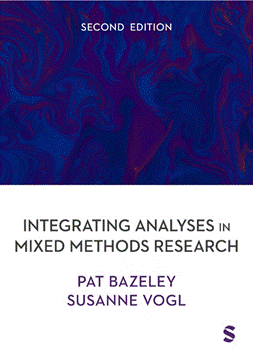
With new chapters and an updated structure, this second edition:
· Examines the basis for and dimensions of integration, introducing a framework to use in your own research;
· Enables you to ensure conversations take place between your chosen methodological approaches so you can reap their full potential;
· Considers how computational approaches like LLMs can aid analysis, while still requiring critical researcher engagement;
Pragmatic and systematic, this is an essential guide for students and researchers conducting mixed methods research.
For further information, and a preview, go to: https://uk.sagepub.com/books/book286238
Table of contents
PART 1 FOUNDATIONS
FOR INTEGRATED ANALYSIS
1 Mixed Methods in
Context
2 Unpacking
integration, the dynamic core of mixed methods research
3 From theory to
practice: approaches to integration and design
4 Design for
integration
5 Working with
data: preliminary considerations
PART 2 INTEGRATIVE
ANALYSIS STRATEGIES
6 Sequential integration: Analysis interfacing with design and further
analysis
7 Combining
diverse approaches in complementary analyses
8 Connect,
compare, and contrast in joint displays
9 Case-based
comparison: integration using matrices and crosstabs
10 Quantifying
qualitative data
11 From counts and
codes to variable data for statistical analysis
12 Exploring
qualitative data with multivariate analyses
13 Transforming
numeric data to create descriptive and narrative accounts
14 Using
integrative strategies in combination: inherently mixed and hybrid methods
PART 3 ENGAGING
WITH COMPLEXITY
15 Complex mixed
methods applications
16 Integrating
computational approaches in mixed methods analyses
17 Exploring
dissonance and divergence
PART 4 NEGOTIATED,
WARRANTED INFERENCES
18 From
integrative analyses to warranted assertions and a coherent, negotiated
account.
Reviews of first edition
Bazeley addresses one of the biggest challenges faced by
mixed methods researchers: the integration of data and interpretation of
results that come from different data collection methods. She does so in a
comprehensive and systematic way that is enhanced by the use of multiple
examples that illustrate multiple mixed methods data analysis strategies.
Bazeley also includes a diagram for each chapter that guides readers, making it
easy to follow the detailed and thoughtful process provided in this important
book. In addition, she demonstrates how integration can be accomplished using a
variety of software packages, thus making this an excellent guide for the new
and advanced mixed methods researcher. Researchers who want to maximize the
data from a mixed methods study will find this an invaluable resource.
Donna M. Mertens, Professor Emeritus, Gallaudet
University
Bazeley is one of the pioneers of contemporary mixed
methods, and writes with authority, clarity, and a wealth of examples that make
her latest contribution both cutting-edge and accessible. Data integration is
now recognised as the heart of the mixed method enterprise and Bazeley gives
the field a definitive treatment of the many approaches, dimensions and issues
in integrating mixed methods data for analytic insight.
Nigel Fielding, University of Surrey
Pat Bazeley has provided a much-needed, in-depth and
thorough treatment of integration in mixed methods as well as the
epistemological and practical considerations involved. The combination of
accessibility and rigour makes this a useful -- perhaps essential -- text for
research students and seasoned mixed methods researchers alike.
Ariel Lindorff, University
of Oxford
Patricia Bazeley has produced a much needed and awaited
text which addresses the main issues and controversies around truly integrated
mixed methods research. A common criticism of those claiming to be utilising
mixed methods research designs is that there appears to be a lack of
integration of the qualitative and quantitative data when analysing data and
reporting that analysis. This very timely book speaks to a very wide discipline
base from behavioural and social sciences, health, nursing and medicine, business
and management fields. The book has value for those who are only just starting
to contemplate utilising mixed methods research and also those wishing to hone
their mixed methods research designs and data analysis techniques.
Ros
Cameron, Australian Institute of Business
|
|
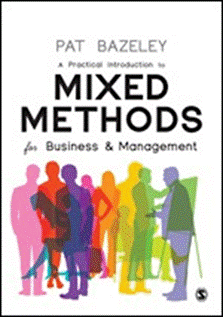
A Practical Introduction
to Mixed Methods Research (London: Sage, 2019) This
book introduces the concepts and debates associated with combining methods,
and illustrates the many benefits and hazards of undertaking a mixed methods
study. Examples from across business and management disciplines bring the
text to life. The reader is taken step by step through the mixed methods
process, from developing a study through designing and conducting it, to
analysing and reporting on the results. Suitable for students and researchers
undertaking their own mixed methods research project. Preview at: https://uk.sagepub.com/books/book263149 |
|
Table of contents 1. Foundations 2. Developing a mixed methods study 3. Designing and conducting a mixed methods study 4. Analysing mixed methods data 5. Bringing it all together Glossary |
Review by Emeritus Professor Ray Cooksey, University of
New England Business School, Australia: Pat Bazeley offers a concise and balanced, yet comprehensive, introduction to the mixed methods research journey from the developmental stages to writing up, laced with examples from the literature and from her own research. This guide will be gold for any social or behavioural researcher aspiring to expand their methodological repertoire. Invest in this book now – it will return that investment many times over! |
Association for Mixed Methods
researchers
The Mixed Methods
International Research Association (MMIRA) has been established with the aim of creating an
international community to promote and support interdisciplinary mixed methods
research. MMIRA seeks to engage with a broad set of approaches in the service
of understanding complex social, behavioral, health, educational, and political
concerns related to the human condition and natural world. Our vision includes
bringing together diverse communities of scholars, students, practitioners,
policymakers, citizens, and other stakeholders, with the goals of expanding
knowledge and producing social betterment and social and global justice.
Members
receive:
- A special e-access subscription to the Journal of Mixed Methods Research and/or the International Journal of Multiple Research Approaches for minimal cost;
- A discounted rate for participation in the
biennial MMIRA Conference that will be sponsored by the Association and
hosted in different places around the world, also for some regional
conferences held in other years.
- Access to resources on the MMIRA Website (mmira.org). These include
research-rich pedagogical materials, an on-line training course, dialogue
among mixed methods scholars and students, and resources and news about
the latest mixed methods initiatives, advances, and conferences.
- Leadership and mentoring opportunities in
the MMIRA organization.
Membership fees are modest, with reduced fees for students,
retirees, etc., and those from developing nations.
To join the
MMIRA, go to Membership at http://MMIRA.org and
complete the registration form.
Oceania regional chapter
of MMIRA (MMIRA-O)
MMIRA-Oceania is a young chapter of the Mixed Methods International Research Association for researchers coming from Australia, New Zealand, and Pacific Nations. The objectives of the Chapter are to:
1. Build a community of, and share expertise amongst, mixed methods researchers throughout the region;
2. Support and build mixed methods research (MMR) capacity for researchers and research students throughout the Oceania region;
3. Contribute to civil society through enhancing the mixed methods research skills of those working professionally in development and policy work, and in practice more generally; and
4. Connect members to the wider global networks of mixed methods researchers.
Find out more about MMIRA-O and become a member by
completing an application form at mmira-oceania.org
Selected
Bazeley book chapters and journal articles on mixed methods
Bazeley, P.
(2024). Conceptualizing integration in mixed methods research. Journal
of Mixed Methods Research, 18(3), 225–234. doi:
10.1177/15586898241253636 (open access)
Bazeley, P. (2023). From
mixed data sources to multimethods and integrative mixed methods. In R. Cameron
& X. Golenko (Eds.), Handbook of Mixed Methods Research in Business and
Management (Chapter 3, pp. 28-40), Edward Elgar
Bazeley, P. (2021). Using
NVivo for mixed methods research. In A. Onwuegbuzie & R. B. Johnson (Eds.),
Reviewer’s guide for mixed methods data analysis (pp. 343–354). New
York, NY: Routledge. Working copy
Bazeley, P. (2019).
Integrative analysis for mixed methods research. In P. Atkinson, S. Delamont,
A. Cernat, J. W. Sakshaug, & R. A. Williams (Eds.), SAGE Research Methods Foundations. doi: 10.4135/9781526421036788352
(available on Sage Research Methods for those whose library has a subscription http://methods.sagepub.com/foundations/integrative-analysis-for-mixed-methods-research)
Bazeley, P. (2018). “Mixed methods in my bones”: Transcending the qualitative-quantitative
divide. International Journal of Multiple
Research Approaches, 10(1) 334-341.
(submitted
copy)
Bazeley,
P. (2015). Writing up multimethod and mixed methods research for diverse
audiences, in S. N. Hesse-Biber & R. B. Johnson (Eds.), Oxford
handbook of multimethod and mixed methods research inquiry (pp. 296-313). New York: Oxford University Press. (submitted
copy)
Bazeley, P. (2012).
Integrative analysis strategies for mixed data sources. American Behavioral
Scientist, 56(6), 814-828. (submitted copy)
Bazeley, P., & Kemp,
L. (2012). Mosaics, triangles, and DNA: metaphors for integrated analysis in
mixed methods research. Journal of Mixed Methods Research, 6(1), 55-72 (submitted copy)
Bazeley, P. (2010). Computer assisted integration of mixed methods data sources and
analyses. In A. Tashakkori & C. Teddlie (Eds.) Handbook of mixed methods research for the
social and behavioral sciences, 2nd edition (pp. 431-467). Thousand Oaks, CA: Sage.
Bazeley, P. (2006). The contribution of computer software to integrating qualitative and
quantitative data and analyses, Research in the Schools, 13(1), 64-74. Download Reprinted in in Vogt,
W. P. (Ed., 2008). Selecting Research Methods (Vol.
4, pp. 1-16). London: Sage.
Bazeley, P. (2003). Computerized data analysis for mixed methods
research. In A. Tashakkori & C. Teddlie (Eds.), Handbook of
mixed methods in social and behavioral research. Thousand Oaks, CA: Sage,
385-422.
(Contact the author for enquiries about book chapters.)